

What’s the point of knowing your jackpot activity?
What does that mean? Well, it’s a bit like when you’re in a state of flow. The concept was introduced by the Hungarian Mihaly Csikszentmihalyi in his book. Flow is described as the optimal experience. You’re enjoying yourself😉
After reading the book, I started to wonder when I’d last experienced flow. I’d probably had it a few times… What characterised those moments? It was a while ago, so it wasn’t that easy to describe the circumstances. Perhaps the common thread was discovering something new. But was that description enough? No! For example, you experience new things when you travel, but that doesn’t mean you’re in a state of flow every time, does it? How could I arrive at a description of the conditions for flow, as far as I’m concerned?
One day it occurred to me – what happens when you use all your dominant factors (strengths) for a particular activity? Surely you must be as motivated as can be. Well, not quite. It’s crucial, but a number of other factors need to fall into place too, such as the values of the culture in which you operate. And other important conditions. BUT it’s clear that when all your strengths are being used, you definitely have a clear picture of your strongest motivation. I call this your ‘jackpot activity’. I can get a good description of this by using the HumanGuide test (personality test), which I’ve been developing since 1986. It also has the significant advantage that the results describe one’s driving forces across eight core dimensions. This provides a more nuanced test result than tests with only four or five core dimensions – such as DISC and tests based on the Big Five model.
So what was my jackpot activity? I wanted to experience flow more often, but how could I achieve that?
Then you formulate your jackpot activity as precisely as possible. It is important to formulate that activity in more general terms. Not too specifically, as that can be very limiting. For example, it is better to define your activity as ‘growing vegetables’ rather than ‘growing asparagus’. But of course, it can be sensible to focus on one or a few vegetables in order to become skilled at growing precisely those. However, make sure that your wording is just the right amount of specific and that it suits you personally.
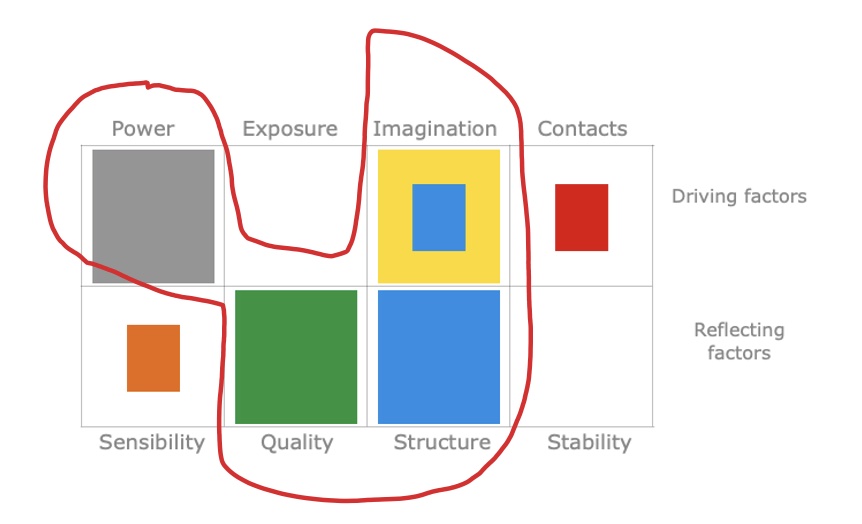
If I take myself as an example, I have these strengths out of the eight possible ones according to the HumanGuide test
- Imagination
- Quality
- Structure
- Power
in that order. See also the picture.
The test is based on a theory comprising eight core dimensions (see humanguide.com for further details), which makes the results more nuanced and useful. It identifies some key characteristics for each
- Sensibility, i.e. caring, empathetic and service-oriented
- Power, i.e. results-oriented, quick and dynamic
- Quality, i.e. responsible, determined and long-term perspective
- Exposure, i.e. colourful, spontaneous and lively
- Structure, i.e. orderly, organised and disciplined
- Imagination, i.e. open-minded, creative and curious
- Stability, i.e. security-oriented, traditional and economical
- Contacts, i.e. people-oriented, easy-going and sociable
Based on the results of that test, I have devised this jackpot activity:
Solving complex problems (Imagination, Quality and Structure, as well as Power) with a positive social purpose (Quality). I do this all the time, which means I am highly motivated and enjoy my life. Had I not had precisely those driving forces, I would definitely not have been able to develop the HumanGuide concept – since 1986!
In fact, I’ve even become a passionaire. Not a traditional pensioner. And I’m happy with that😉
When I look around at people my own age, I sometimes get really shocked. They don’t seem to be having much fun. Some are ill and others have died. There may, of course, be many reasons for this, but I think those who have a strong passion are definitely more lively. They lead a free life, where they can give free rein to their strengths (driving forces) and do something they find meaningful.
Now, bestselling author Jim Collins has come to a similar conclusion. This is set out in his recently published book, What to Make of a Life. The book is based on 10 years of research into people who have faced a major obstacle and how they have managed to overcome it – the mountain.
The book also contains a number of tips; for example, if you find yourself in a fog at the foot of the mountain, you can apply the principle of ‘simplicity stepping’. This involves thinking about what small steps you can take that seem sensible. The key is to carefully consider decisions that are irreversible.
It is interesting to note that these people were not driven by money or the desire for fame. They were driven by their ‘encodings’, which I interpret as ‘jackpot activity’. They had such a strong drive that what they did could be seen as a hobby. What they did was also a valuable contribution to society, which provided extra motivation.
By the way, influencers – you can only keep it up for long if what you do aligns with your main activity.
Why not formulate your own jackpot activity? Note, however, that the examples in Jim Collins’ book were not aimed at being admired. Being mentioned in prestigious contexts. Becoming rich. They simply wanted to work on something that gave them great satisfaction. Some, however, went on to win the Nobel Prize and the like…
You can take the test here: humanguide.nu
Once you’ve done that, you can also calculate your passion index – for example, how well your personality suits a particular job. You can do this using the web app at your.humanguide.se
Good luck!
Rolf
P.S. My jackpot activity helped me a great deal to keep going when I was seriously ill in the spring of 2025. Overall, having a clear picture of my jackpot activity has made it easier for me to navigate for a good life.
Why not subscribe for my newsletter HumanGuide News? Then click here... It is on Linkedin (every second week)
- Created on .