

Why did the nuclear engineer become a bee entrepreneur?
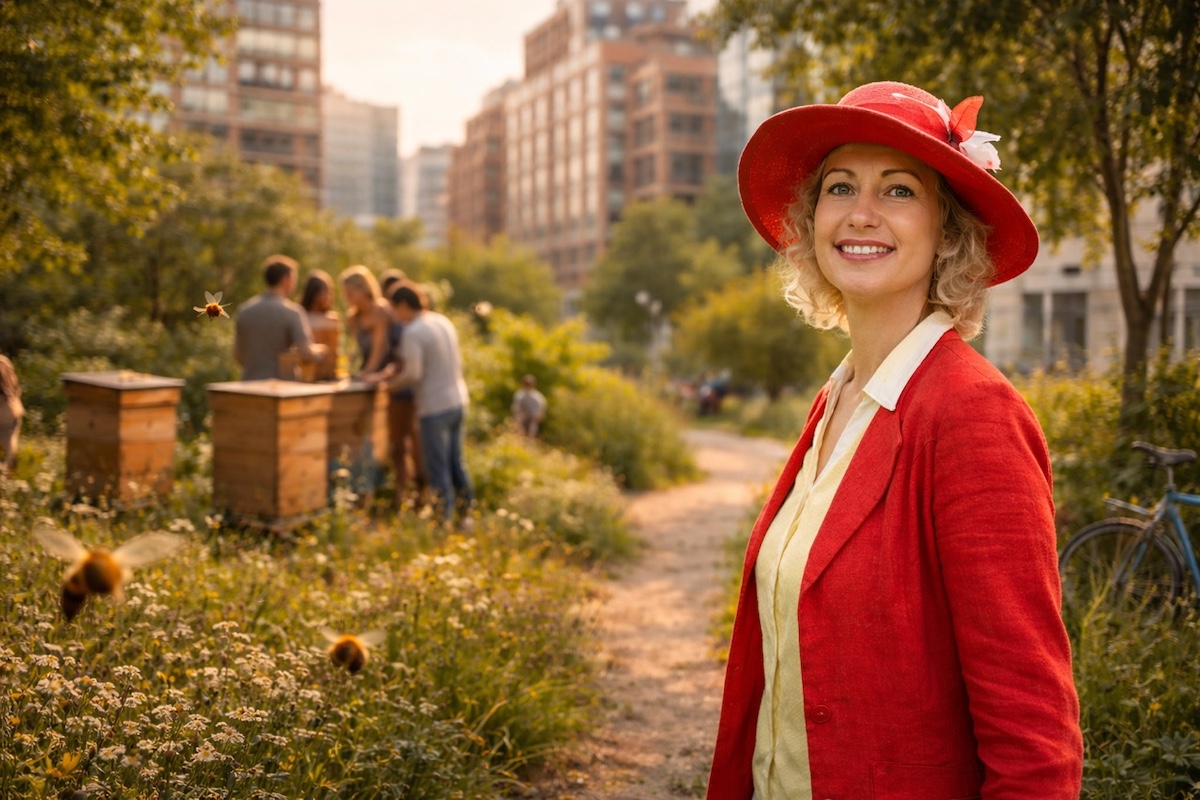
Nine years ago, Katja Göller took the HumanGuide test…
Her feedback at the time was: ‘I’ve taken many personality tests. This was the first one that helped me understand why I was unhappy at work.’
When I met her nine years ago, she was a bee entrepreneur. We’ve kept in touch from time to time over the years. Among other things, we developed a collaboration using the bee colony as an example for good cooperation;-) so we created profiles for the queen, the drones and the worker bees. The idea was to use this as an example in team development.
Now we have met again, as Katja wanted to retake the test because a lot had happened – for example, she had recently separated from her partner. Their personalities were too different. In a relationship, people should have similar personalities (according to research), so that they, for example, want to do similar activities and spend time together. Katja felt that her personality had changed since growing up in East Germany. She has been used to conforming (authoritarian culture), but now she wants to discover herself to a greater extent – who she really is.
Normally, one’s personality doesn’t change all that much once one has become an adult. That is why it makes sense to take personality tests. However, changes can occur, for example, if something has been suppressed within a culture and/or in a relationship. That is why I asked Katja if she would be willing to share her story, partly to encourage others to reflect on their own lives and their future. Here it is…
It also serves the purpose of helping more people understand how personality plays a part in making good career and relationship choices. If you have a clear and nuanced understanding of your personality, it becomes easier to make good choices. That is why we have set up an e-shop for private individuals, where they can purchase the test with or without coaching. Prices from 300 including VAT.
The insight!
“I did everything right – but it still felt wrong. I had a good job. I was earning well. I had the qualifications, the title and the security.
And yet I sat there with a feeling I couldn’t ignore:
Is this my life? Am I going to do this for another 30–40 years?
The answer that came was as clear as it was uncomfortable: No!
Carrying on would have felt like throwing my life away.”
Proving one's worth
My journey began long before that. I grew up in East Germany as the youngest daughter. When it came time to choose a course of study, I asked my dad:
“What do you think I should become?”
He replied: “A laboratory assistant.”
It was as if a light had gone on inside me. Is that how you see me?
In that moment, I made up my mind:
I’m going to prove that I can become an engineer – just like my big brother.
And that’s exactly what I did.
I trained as a civil engineer in industrial economics. I performed well, progressed and went on to specialise in nuclear power. I set myself a clear goal – to write the best thesis – and I won the prize.
I did everything ‘right’. But something was missing.
When performance is no longer enough
I worked as a consultant in the nuclear power industry. It was a world of analysis, safety and structure. Everything was precise. Everything was under control.
And for me – completely lifeless. I wanted to move forward, I wanted to create, I wanted to contribute ideas.
But I was met with comments such as – “A new era is coming.”
I felt even then – When that time comes – I won’t be here anymore.
Money wasn’t the problem. But money couldn’t replace the sense of purpose.
Beekeeping – something else is beginning to grow
Back in 2010, when I took a leave of absence to study nuclear power, I started beekeeping. It was a small-scale operation at the time. But it felt alive in a way that nothing else did.
A life that was impossible to balance
The years went by. I had children (in 2013 and 2015).
I continued to work as a consultant. At the same time, my beekeeping business grew.
Eventually, I found myself juggling three lives at once
- consultant
- parent of young children
- beekeeper and entrepreneur
In 2016, I took a leave of absence to try my hand at running my own business.
I went back for a short while – but I knew straight away: This isn’t working anymore.
In 2017, I handed in my notice and became a full-time entrepreneur. Not because I had all the answers. But because I knew I couldn’t go back.
The first time I really stepped forward
But in truth, I had already proven to myself who I was.
Around 2021, I got involved with a small group in a local campaign to protect nature. A large natural area was under threat from development involving wind turbines. We were all different – and that was our strength. I was the one who came up with ideas and took the initiative. Another member of the group was organised, wrote and handled the formal paperwork, including liaising with the court. I was often the one who dared to stand out.
I contacted politicians. I helped organise meetings – and chaired them. I stood and spoke for hours in front of people. And I did all this during a period when I was actually on sick leave due to burnout.
I also stood in the town square and spoke. Not because anyone asked me to.
But because I felt: I have to do this. If we don’t do it – who will?
Many people around us were more vulnerable and had more to lose by speaking out. I could take on that role – and I did.
In the end, there was no wind farm.
The Turning Point – a quiet realisation
When life was at its most hectic, I thought: I need to scale back my beekeeping.
But then a calm, almost serene realisation dawned on me – No… it’s actually the opposite.
It wasn’t the bees that needed to go. It was everything else that no longer suited me.
Today – creating something that matters
I currently run BeeNature
A year ago, I built a mobile honey extractor – a trailer that allows me to visit schools and let children extract their own honey.
The vision is simple yet powerful
- that children should be able to experience nature first-hand
- to understand bees, pollination and our role in the ecosystem
The approach is practical
- schools can book a visit
- around 90 children take part over a few hours
- the experience is funded by local businesses
Companies are given the opportunity to contribute to society, strengthen their sustainability efforts and, at the same time, be part of something meaningful.
Understanding one’s own power
For many years, I believed that my strength lay in my drive and my achievements. But over time, I have come to realise something else
- My greatest strength is my imagination;
- And even more so – my sensitivity and intuition
Today, I dare to listen to it. My gut instinct often knows the way before my brain understands. And when I follow it – the logic falls into place afterwards.
Freedom, courage and purpose
For me, life is no longer about fitting in. It’s about
- make a difference
- work in harmony with nature
- connect with people on a genuine level
- and use my energy without going against my true self
I do things with determination – but not by force. I do it together with others.
If only I’d known sooner…
Sometimes I wish someone had spotted me sooner. Seen my imagination. My entrepreneurial spirit.
Perhaps I would have started this journey earlier. But at the same time, I know: this is my path.
And I walked it.
To anyone who can relate
If you have a “good life” – but the feeling isn’t right: Listen to it!
It isn’t a problem. It’s a sign.
You don’t need to have all the answers. But you do need to be brave enough not to stay where you don’t belong.
I once thought I needed to become someone else to succeed.
Today I know: I just needed to be more of who I already was.”
Katja's first test results
This is how it was
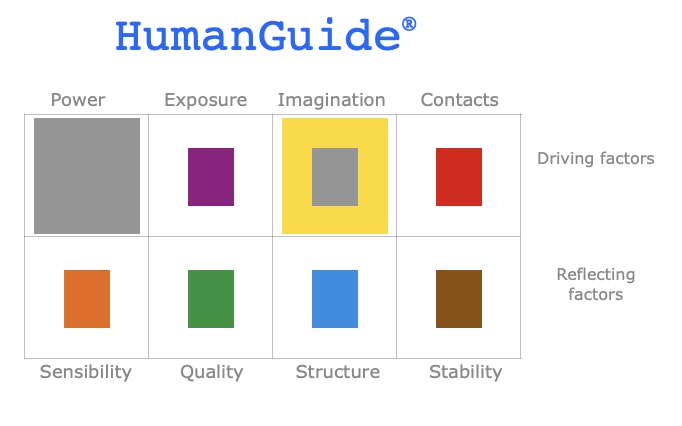
The test is based on a theory comprising eight core dimensions (see humanguide.com for further details), which makes the results more nuanced and useful. It identifies a number of key traits for each
- Sensibility, i.e. caring, empathetic and service-oriented
- Power, i.e. results-oriented, quick and dynamic
- Quality, i.e. responsible, determined and long-term perspective
- Exposure, i.e. colourful, spontaneous and lively
- Structure, i.e. orderly, organised and disciplined
- Imagination, i.e. open-minded, creative and curious
- Stability, i.e. security-oriented, traditional and economical
- Contacts, i.e. people-oriented, easy-going and sociable
As you can see, her personality is dominated by Power and Imagination. That combination can lead to tunnel vision and exhaustion-induced depression. It was Imagination that she really didn’t get much opportunity to express in her job as a nuclear engineer. Otherwise, she was quite versatile, which may have been because she set out to fit in by adapting. In the end, it became too much for Imagination, so she resigned.
Katja's results 2026
Here are the test results now
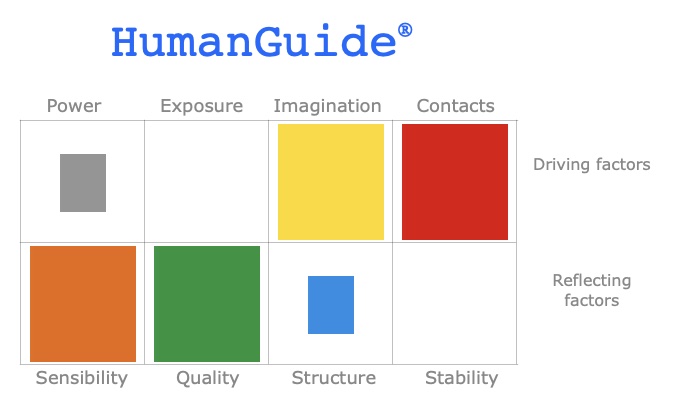
Her experience is not that her need for social connections has increased as a result of the separation. I have now rediscovered a side of herself that has always been there.
During the years she spent in her previous relationship, she was part of a social circle and a community where there wasn’t really room for social connections. We had very few shared social contacts. Instead, I created my own circles – for example, through meetings in other settings, where I could fulfil an important need for her.
What she is experiencing now is therefore not a new or temporarily heightened need, but a reconnection with her own nature. A part of her that has always been strong, but which has not been fully given space.
Furthermore, Katja now knows that it is really important for her to avoid a new partner with a high score in Stability. On the other hand, Imagination and social factors are important qualities to look for in a new partner.
Here is her LinkedIn profile
https://www.linkedin.com/in/katja-göller/
NB! If you would like to gain a clearer understanding of your own personality, you can purchase the test with or without coaching in our eShop here: humanguide.nu. Prices from 300 SEK incl. VAT.
- Created on .