

Will your children choose a suitable career path and, consequently, a course of study?

Many young people are unsure. They don’t really know what different jobs entail. Nor do they know what sort of personality (driving forces) they need to have in order to enjoy the job – in the long run.
Parents are also unsure. Naturally, they want their children to do well in life, but how should they offer advice when it comes to careers and, consequently, education? Many are disappointed with the help they receive from school.
So how can one make good choices?
At its core, it is primarily about the girl’s or boy’s personality (driving forces) and values. Then, of course, describing what sort of person one needs to be to thrive in a particular job. People know their values, but few can describe their personality in a clear way. This applies to adults too…
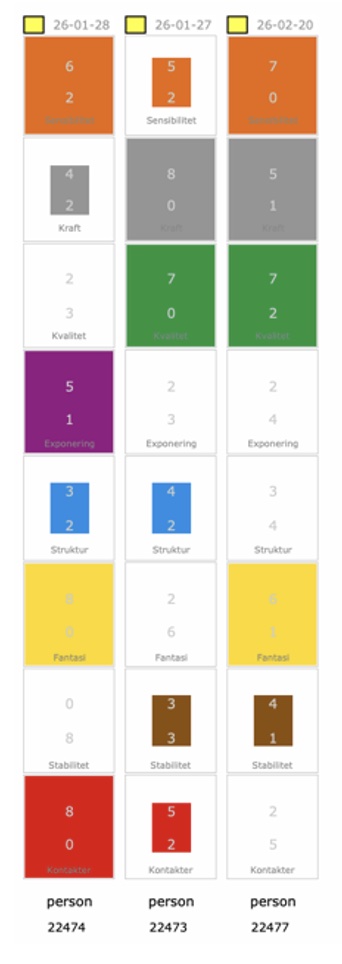
You can identify your personality using a personality test. We use the HumanGuide test, which consists of eight core dimensions (more details at humanguide.com), making the results more nuanced and useful. These include a few key traits for each
- Sensibility, i.e. caring, sensitive and service-oriented
- Power, i.e. results-oriented, quick and powerful
- Quality, i.e. responsible, determined and forward-thinking
- Exposure, i.e. colourful, spontaneous and lively
- Structure, i.e. orderly, organised and disciplined
- Imagination, i.e. open-minded, creative and curious;
- Stability, i.e. security-oriented, traditional and thrifty;
- Contacts, i.e. sociable, easy-going and outgoing;
Here is an illustrative example of a poor career choice for a young woman. She took a summer job as a postwoman. She was dismissed after just three days. Why? Her most dominant need was Contacts (see above). In the postman’s job, there is very little opportunity for connections. First, the postman sorts the post – alone. Then the post is delivered – alone…
For several years, the test was used to help students improve the composition of their teams in so-called UF companies (Young Enterprise in Sweden). The reason was that the teams tended to be ‘cloned’, i.e. very homogeneous. The teachers explained that the teams needed to be more diverse in order to be successful. With the help of the test results, it then became easier to create diverse teams. Furthermore, this led to good collaboration, as they came to understand each other’s personalities.
By having the students take the test, I tried to get them to realise that they could use their test results to get good ideas about suitable career choices. Unfortunately, this fell on deaf ears. It had bothered me for a long time, but then I had an idea…
Why not do the test with my deck of cards instead of digitally? When I tried out the idea for the first time, it was with an 18-year-old lad. After a while choosing cards – typical or not typical of me – he exclaimed: ‘Now I’m really excited! It’ll be exciting to see the result…’ He’d brought his girlfriend along. That was valuable because sometimes they’d agree together on what he should choose.
We concluded that his strengths were Sensibility, Exposure, Imagination and Contacts. See below, i.e. the first column… (see the profile below)
In the second and third columns are the profiles of two estate agents. Why? Well, when I asked the lad if he’d considered any particular profession, estate agent was one of the options. So I got in touch with two who were interested in taking the test. It’s clear that neither is a perfect match for the lad. This is because:
- Both estate agents have Power and Quality, but the lad does not. Power is needed to take the initiative, be results-oriented and courageous in certain situations. Quality is needed because buying and selling a property requires a great deal of trust
- The guy’s strengths are Exposure and Contacts, which could lead to him talking too much. Admittedly, he has Sensibility as a strength, but that probably reduces the risk of a bit of...
- The strength of Imagination can be good in sales, but the other risks associated with the profile are too great
Now I’ve got a taste for it, so I’m going to think about how I can get in touch with schools that want to help their pupils make good choices regarding their educational pathways. And parents too…
I’ve also set up a new online shop where you can easily buy the test, with or without coaching – humanguide.nu. Once you’ve taken the test, you’ll also get access to the web app your.humanguide.se, which puts ‘knowledge in your pocket’, i.e. on your mobile.
It would be great if this approach could improve school and career choices. On the other side of the scale are rising levels of mental ill-health and a lack of motivation in many workplaces.
I’m starting with Sweden😉
- Created on .