

How can one make sense of Mr Trump’s behaviour?
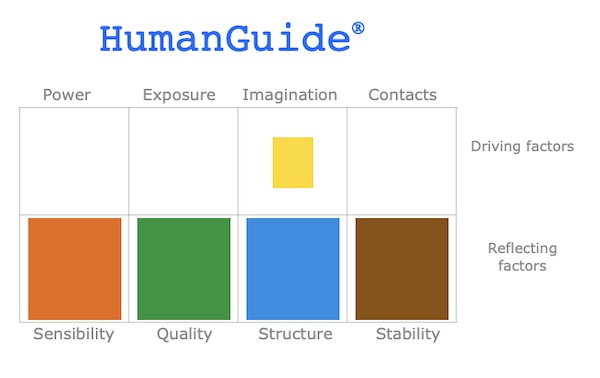
Well, not exactly. First, let’s consider Swedish culture as a sort of contrast. The extreme version of our culture can be illustrated by Ove, that is, the main character in the book and film A Man Called Ove. To describe Ove, I’ll use the Eight Boxes personality theory. In my view, his personality looks like this:
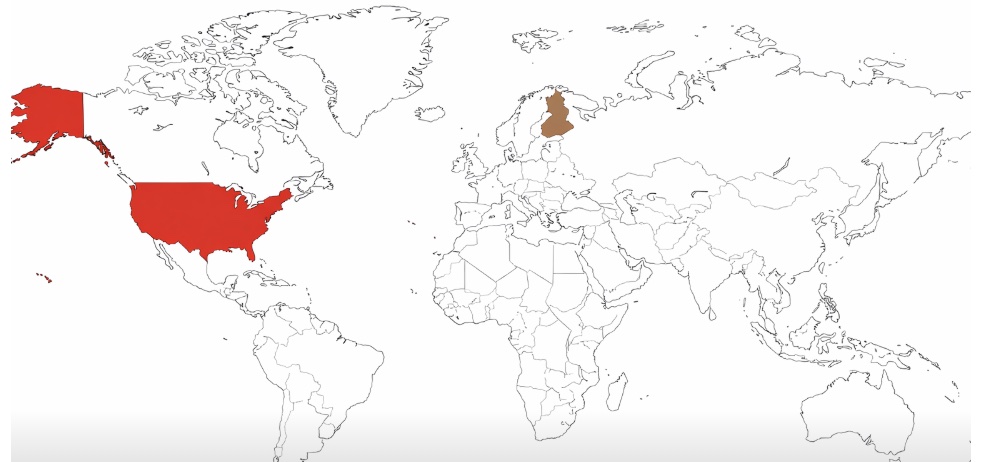
(How did I arrive at that conclusion? By asking a group of people and having lived in Sweden for 79 years… Note on the map that ChatGPT confused Sweden with Finland...)
The test is based on a theory comprising eight core dimensions (see humanguide.com for further details), which makes the results more nuanced and useful. It identifies a number of key traits for each
–Sensibility, i.e. caring, sensitive and service-oriented
–Power, i.e. results-oriented, quick and powerful
–Quality, i.e. responsible, determined and forward-thinking
–Exposure, i.e. colourful, spontaneous and lively
–Structure, i.e. orderly, organised and disciplined
–Imagination, i.e. open-minded, creative and curious
–Stability, i.e. security-oriented, traditional and thrifty
–Contacts, i.e. sociable, easy-going and outgoing
If you think about Ove, he’s very principled. He’s happy to help others, supporting them in various ways. On the other hand, he gets angry when someone doesn’t act in a way that aligns with his values. All of this is typical of Quality.
He acts rationally and likes to plan what he’s going to do. He works methodically. These are typical behaviours of Structure.
Furthermore, he has his habits and they are important to him. He does not like change and is protective of what is his. Typical of Stability.
Beneath this surface lies a great deal of thoughtfulness and warmth, but it is not so clearly visible. He can even be loving. This is how those who place a high value on Sensibility behave.
Can a culture then be described using a personality theory? I would argue so, as it is a group of people who shape a culture over time. Many are involved, so a culture changes slowly.
Ove can be seen as an extreme version of Swedish culture.
I would, however, like to add a sort of caveat to this description of Swedish culture, as there are now many examples of entrepreneurship. I see it as the Viking culture having been ‘reborn’ (think of it as 2.0), manifested in companies such as Spotify, Klarna and Lovable.
Speaking of entrepreneurial culture, one could describe US culture as characterised by entrepreneurship. Of course, there are many people in the US from diverse backgrounds, but if one were to highlight something that is very strong in the US, it is precisely that. Like everything else, it has its pros and cons – just look at the rise of tech entrepreneurs.
I’ve been given a good explanation as to why it turned out that way. Think about it – history. For example, around 25% of Sweden’s population emigrated, mainly at the end of the 19th century. What they had in common was that they were fleeing very difficult conditions and, on top of that, had to cross the Atlantic. That makes for strong individuals with entrepreneurial qualities, doesn’t it?
So how can one describe US culture using the Eight Boxes? Well, like this
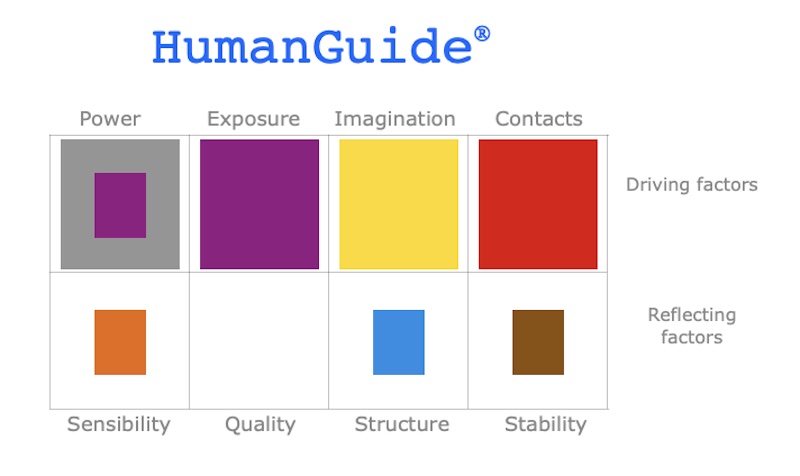
(How did I arrive at that conclusion? By asking a small group of people living in the US. Of course, there are many cultures in the US, as its inhabitants come from many different countries around the world. However, this particular type of culture tends to dominate, as it is highly influential. Furthermore, I have closely followed Mr Trump in the media, as his actions can influence the whole world.)
Mr Trump can be seen as the extreme version of US culture.
This then becomes the opposite of Ove’s Swedish culture. A small detail. In this version, there is a ranking of the primary factors. This is shown by the grey box containing a smaller purple box. This means that Power is the core factor and Exposure is the secondary factor.
So what are the consequences of this? Well, it leads to quick decisions. Challenges are welcomed. Competition is encouraged. All typical of Power.
One wants to shine. To be in the spotlight. Never to be seen in a bad light – especially not by one’s own audience. Exposure.
One thinks freely and it is important to safeguard one’s independence. One may have unrealistic ideas, but remember that new approaches are often seen as unrealistic – especially the bold ones. This is, of course, Imagination.
Finally, one likes to talk. Not so inclined to listen. Moreover, one really enjoys being in company. Contacts.
It is surely obvious to everyone that a person like this is unpredictable. It is impossible to make any reliable predictions based on past behaviour and logic. Well, sort of. Of course there are patterns, but with many exceptions.
So how can one act to influence someone with this sort of personality? Well, everyone has their priorities. Returning to the Eight Boxes theory, each factor has a kind of ‘ok’. This is the decisive driving force behind the factor. For Power, it is a performance-based yoke (exaggerating the strength), i.e. if you lose, it’s no fun. However, it is difficult to argue with someone like this, as they must win – have the last word. It’s much smarter to ask questions? But that can lead to problems, as the person doesn’t want to be left without an answer.
Exposure has an audience yoke, i.e. it’s about staying in the public eye. Preferably, the audience should grow. Criticising someone with a great need for Exposure in front of their audience can make them an enemy for life. It’s much smarter to do it in private. If done correctly, it can instead be greatly appreciated, i.e. the person doesn’t make a fool of themselves in front of their audience.
When it comes to Imagination, one has a ‘freedom’ mindset. One is truly allergic to anyone who bosses people about. One must be non-directive. Feel free to ask questions if something seems unrealistic. Don’t start with criticism.
By the way… Mr Trump thinks outside the box. In fact, he has few boxes… He isn’t too fussy about details. For example, MAGA. Make America Great Again. That isn’t right. America is a continent. The correct term is MUGA…
Finally, for Contacts, the aim is to be appreciated within the group. Here, it’s a social faux pas, but it’s usually harmless…
Hopefully, this article has provided greater understanding and ideas for smarter behaviour.
Do you agree with my reflections?
If you’d like a clearer understanding of your own personality, you can find out via humanguide.nu…
- Created on .