

Young people find it very difficult to choose a suitable career and course of study…
It’s not easy for someone aged around 17 to make a choice. Nor is it easy for parents to help them make that choice. Furthermore, many are disappointed with the support provided by the school. Choosing a career is, of course, the most important thing, but it must also be supported by the chosen course of study.
So what determines whether it will work out well? The main thing is that there is a good match between the job and one’s personality, values and abilities. On the other hand, many people choose based on the professions they are familiar with, what they will earn, perhaps even the future options of the profession, where they will live, and so on. There are two important and uncertain factors in the decision-making process
- What is the job actually like? You usually know very little about that…
- What is my personality like? What drives me? Of course, many people have an idea and have even received some feedback from others, but it isn’t particularly nuanced. Moreover, it is rarely based on any kind of well-thought-out framework that can serve as a common language
Taking a personality test
A fellow consultant realised the importance of making a good choice, so she asked if her daughter could take the HumanGuide personality test, which she herself had had good experiences within her consultancy work. I was keen to help, as it was an important decision they had to make.
The test was taken about 10 years ago.
My daughter took the test and this was the result
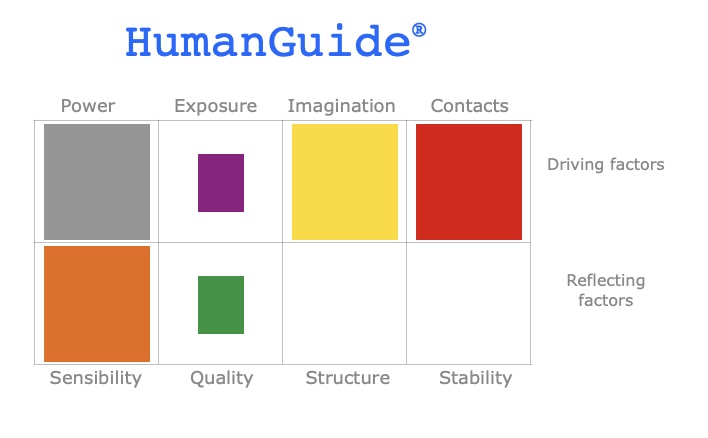
The test is based on a theory comprising eight core dimensions (see humanguide.com for further details), which makes the results more nuanced and useful. It identifies a number of key traits for each
- Sensibility, i.e. caring, empathetic and service-oriented
- Power, i.e. results-oriented, quick and dynamic
- Quality, i.e. responsible, determined and long-term perspective
- Exposure, i.e. colourful, spontaneous and lively
- Structure, i.e. orderly, organised and disciplined
- Imagination, i.e. open-minded, creative and curious
- Stability, i.e. security-oriented, traditional and economical
- Contacts, i.e. people-oriented, easy-going and sociable
The daughter’s results show that she is more driven than reflective – that is, three fully coloured boxes in the top row and one in the bottom. It’s fair to say straight away that there aren’t really any ‘good’ or ‘bad’ personalities. Instead, it’s about how well someone fits with a job, a culture, a life partner, or…
I then asked if she had any idea of a job she’d like. She really wanted to be a paediatrician!
I was impressed by such a specific choice, so I wondered how she’d come up with it?
She’d often mentioned wanting to be a doctor. She also enjoyed being around and working with children. It turned out she’d even done a school placement with a doctor.
How did this fit with her personality? When the focus is on children, a high score in Sensibility is very relevant. It’s important to be empathetic towards both children and parents. To be able to listen and provide reassurance.
As for her other strengths – Power, Imagination and Contacts – these are factors she will need to consider in future choices.
Education and employment
So how did the daughter choose?
Well, the thing was that in her class they awarded ‘Nobel Prizes’ to those who excelled in a particular subject. She won the prize for social studies, so she chose that stream. She did this even though she had originally been on the science stream, with a view to getting into medical school. Even during her first year, she realised it wasn’t the right choice for her, but she didn’t think it made sense to change streams now, so she finished her sixth form in the stream she’d chosen.
After that, she spent a year in Australia.
When she returned to Sweden, she completed her science subjects through adult education (Komvux) so that she could gain entry to medical school. Her grades weren’t high enough, so she also had to study at a folk high school to gain entry to medical school.
She was accepted and is now in her third year.
My thoughts and tips
A high score on Sensibility isn’t just relevant for children – it applies to adults too… Other strengths should be taken into account in future choices.
Furthermore, I have suggested that she should look into whether a low score on Structure might pose a challenge in her role as a doctor.
She has also been advised to use the web app your.humanguide.se, where she can ask someone in a particular role to describe the personality requirements for that job. This will provide her with a comparison of her own personality against the specific requirements of that role.
She has also been given the micro-guide: I’m thinking about a new job, but will it work out?
I also suggested that she could define her ‘jackpot’ activity. What does that mean? Well, it’s what you do, in principle, when you use all your strengths at the same time. Then the job can become like a ‘hobby’. My own is ‘Solving complex problems with a positive social purpose’. In doing so, I use my strengths: Power, Quality, Structure and Imagination. I do this all the time, so I’ve even become passionate about it ;-) The beauty of having a ‘jackpot activity’ is that you have a clear vision to strive towards. At the start, you might only have a few strengths that you use, but because you have a clear goal, you know where you’re heading and those around you notice it too, which can generate support in various ways.
You can also ask AI, such as ChatGPT, for tips and facts about jobs.
It will be interesting to follow up on this once she has completed her medical training and has been in a job for a year or so…
Feedback
So what do the daughter and her mother think about the benefits of taking the test and our new meeting?
The daughter: I thought it was fun to take the test when I was 15. I still do. But because I didn’t take the results seriously when I was 15, I’ve had to live with the consequences.
I won’t be choosing a specialism for another few years. I still have very limited insight into most specialisms, but hopefully it will be easier to make a suitable choice, partly because of the test.
It depends on having a fully motivated individual in front of you when the test is taken.
The mother: After meeting Rolf and taking the HumanGuide test myself, I realised what a useful tool it was for gaining greater confidence in one’s choices.
That is why I asked Rolf if my daughter and some of her friends could take the test. It became clear what would be best for her, but it’s not always easy to stick to what you know, especially at such a young age. I am happy and grateful that she held on to her dream of becoming a doctor and that, thanks to her strength, she worked determinedly and was accepted onto the medical degree programme.
NB! If you would like to gain a clearer understanding of your own personality, you can purchase the test with or without coaching in our eShop here: humanguide.nu. Prices from 300 SEK incl. VAT.
- Created on .