

How can you make diversity in teams work?
Many people recommend that teams should be diverse, but… In a way, this goes against human nature. A clear stage in psychological development is identifying with a particular group. That is where one feels secure. Conversely, one tends to be sceptical of other groups.
Conversely, one tends to be sceptical of other groups. This can create an ‘us and them’ attitude. This is evident during recruitment; in other words, it feels safe to hire someone else who is much like us. This can then lead to significant recruitment or staffing errors, i.e. a poor match for the job.
So how can this be counteracted? Well, if you first draw up a clear specification of the personality requirements for the job, you’ll have a solid basis for both finding suitable candidates and assessing them professionally. Otherwise, it’s easy to favour candidates who resemble your own personality.
When you have a team, you can improve how it functions – despite great diversity – by fostering an understanding of each other’s personalities. A good personality test can be of great benefit here – especially if it is easy to use and comes with good support. I believe, of course, that our personality test – the HumanGuide test – fulfils these criteria well. This is at the heart of the concept of the same name.
A key strength is that the test comprises eight core dimensions, which means the test results are more nuanced than, for example, DISC and tests based on the Big Five model. The concept also includes the web app your.humanguide.se, which has four key features
- Personality dictionary with advice
- My Personality Profile, i.e. where you can view it and receive feedback
- My Personality Chemistry, i.e. where you can save important people in your immediate circle and analyse your personality chemistry with them
- My PassionIndex?, i.e. how well your personality suits a particular job, a particular culture and a particular person
Furthermore, there is, for example, the book Let Your Personality Bloom, which has been published in Swedish, English and Portuguese (Brazil). It is also available as an e-book in the first two languages. Development of the test began in 1986 and it is now available in fifteen languages.
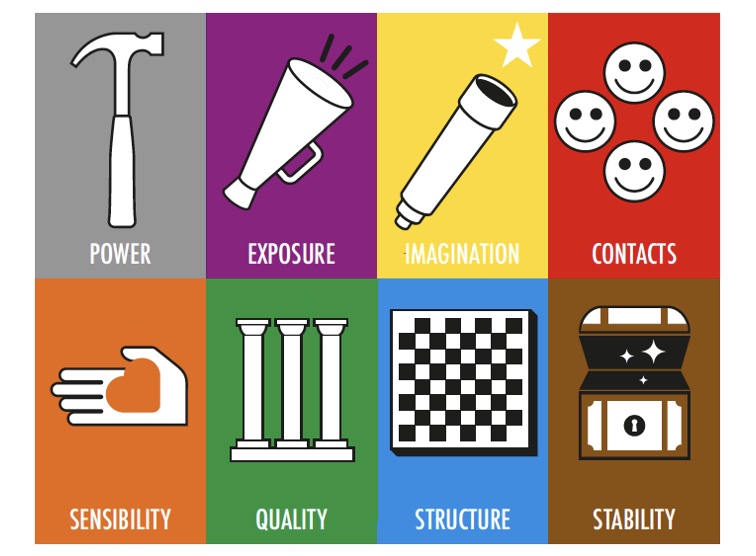
So what are the basic dimensions of the theory? Well, they are as follows (for more details, see humanguide.com)
Sensibility, i.e. caring, empathetic and service-oriented
Power, i.e. results-oriented, quick and dynamic
Quality, i.e. responsible, determined and long-term perspective
Exposure, i.e. colourful, spontaneous and lively
Structure, i.e. orderly, organised and disciplined
Imagination, i.e. open-minded, creative and curious
Stability, i.e. security-oriented, traditional and economical
Contacts, i.e. people-oriented, easy-going and sociable
For information, all factors are compatible with one another according to the ‘Law of Reciprocity’, with one exception – Exposure. If two in a team have it as dominant, then they may become rivals for attention within a team.
- Unfortunately, I have noticed that many laypeople think that tests are more or less the same. They are not, for example
- Do they have good psychometric standards, such as reliability?
- Have they been used in scientific research?
- Is there good support for a layperson to use the results?
- etc
I have also noticed a great deal of ignorance amongst laypeople when it comes to personality; for example, many people who know me and my wife believe that we are really quite different. We are not, if you look at the results of the HumanGuide test. I often get that comment when I say that, in a good relationship, partners should have similar personalities. This has also been confirmed by research. There is, for example, a strong logical argument: if you have very different personalities, you will naturally want to do different things during your free time together. So why be together?
We share Imagination, Structure and Quality, but my wife is a midwife, so she scores higher on Sensibility, whilst I, as an entrepreneur, score higher on Power. In fact, I got divorced in 1993 and met my wife six months later. After a while, I wanted to play it safe, so I asked if she’d like to take the HumanGuide test. She said YES and the prognosis was good😉 We’ve actually been together ever since without a single destructive conflict! Of course we have conflicts, but they’re healthy, so they’re dealt with constructively.
Note, then, that in a team at work, diversity is best, so that all tasks can be handled effectively. But of course, there may be certain traits that are more dominant within the team, depending on the team’s tasks.
Furthermore, we have developed an exercise/method to optimally solve a difficult task for a team. The aim here is also to learn how to make the best use of the eight strengths.
The origin of this idea comes from de Bono’s Six Thinking Hats. Here, of course, there are eight… The method essentially involves using the strengths in a specific order. Everyone in the team should ‘assign’ their greatest strength to a role, as effectively as possible; for example, the person with a high ‘Imagination’ score should take on that role. When applying this method, you must, of course, do your best whilst taking into account the team members. The method naturally means that the team can clearly see whether they are well-staffed – in other words, it can be a real eye-opener.
Incidentally, there is a simple method for maintaining good speaking discipline in a team – the Native American ‘talking stick’, i.e. only the person holding it is allowed to speak. This can be a major challenge for some of the eight strengths, i.e. when someone overuses their strength – overdelivers.
Here’s how it works…
Please note that the person in charge of a function effectively has the floor – acts as chair – when that function has overall responsibility
- Steering (Structure), which starts and stops the process, clarifies objectives, steers the process, and keeps the focus on the objective
- Creativity (Imagination), which focuses on solutions – for example, thinking in the opposite way or from different perspectives, exploring other existing solutions, and sketching out what it would be like if a miracle were to happen
- Risks (Stability), which addresses what could go wrong, carries out risk analysis, asks whether what we have is good enough, whether it’s really urgent, whether this works elsewhere, and whether we’ve missed anything
- Opportunities (Contacts). After Stability, things can get a bit ‘depressing’, so this optimistic strength highlights opportunities, investigates whether anyone can testify to why this is a good thing, and wonders whether this will make us happier
- Feelings (Sensibility), which asks what feelings this might evoke – whether they are negative, positive or neutral – and rates the intensity of these feelings on a scale of 1–10.
- Results (Power) which focuses on what outcomes this will yield; can we reach the goal more quickly; do we need to do this thoroughly; do we need so many people involved; when can we stop?
- Long-term (Quality) which asks whether this will stand the test of time; do the measures fit with our culture and values; is this fair?
- Presentation (Exposure), which asks how this should be presented, who is affected, and which channels should be used
Think of this as a general guide, i.e. a rough outline. A bit like a checklist. This method is particularly well suited to complex problems or challenges. Otherwise, it may be too ambitious.
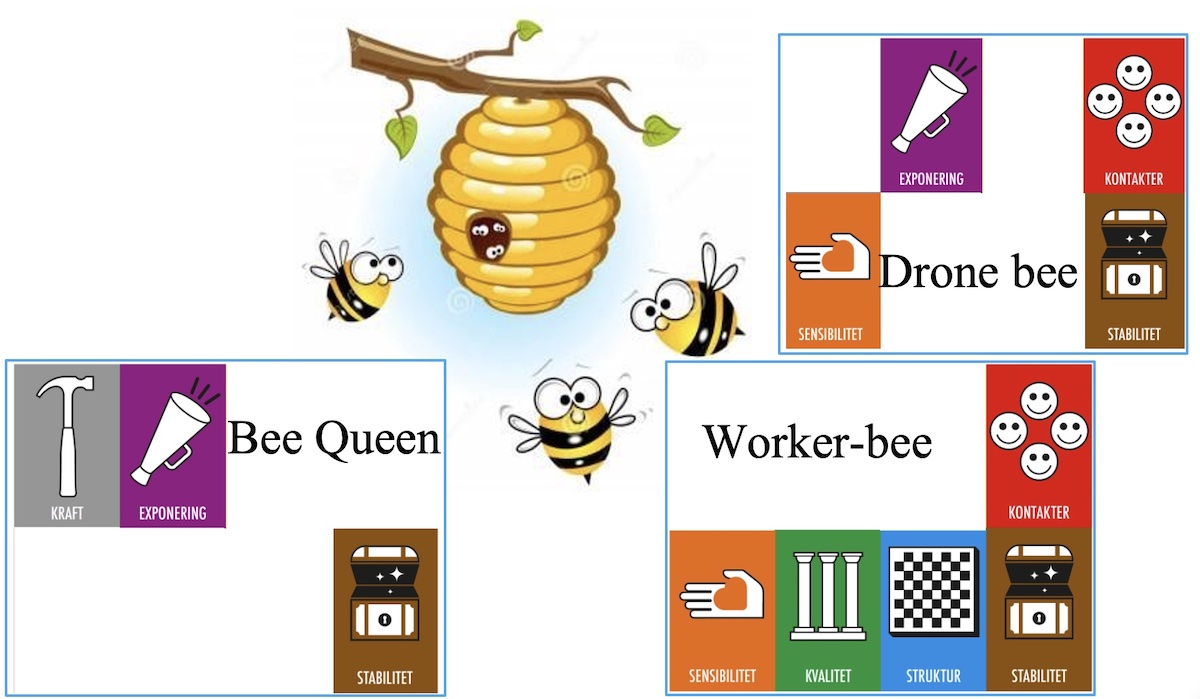
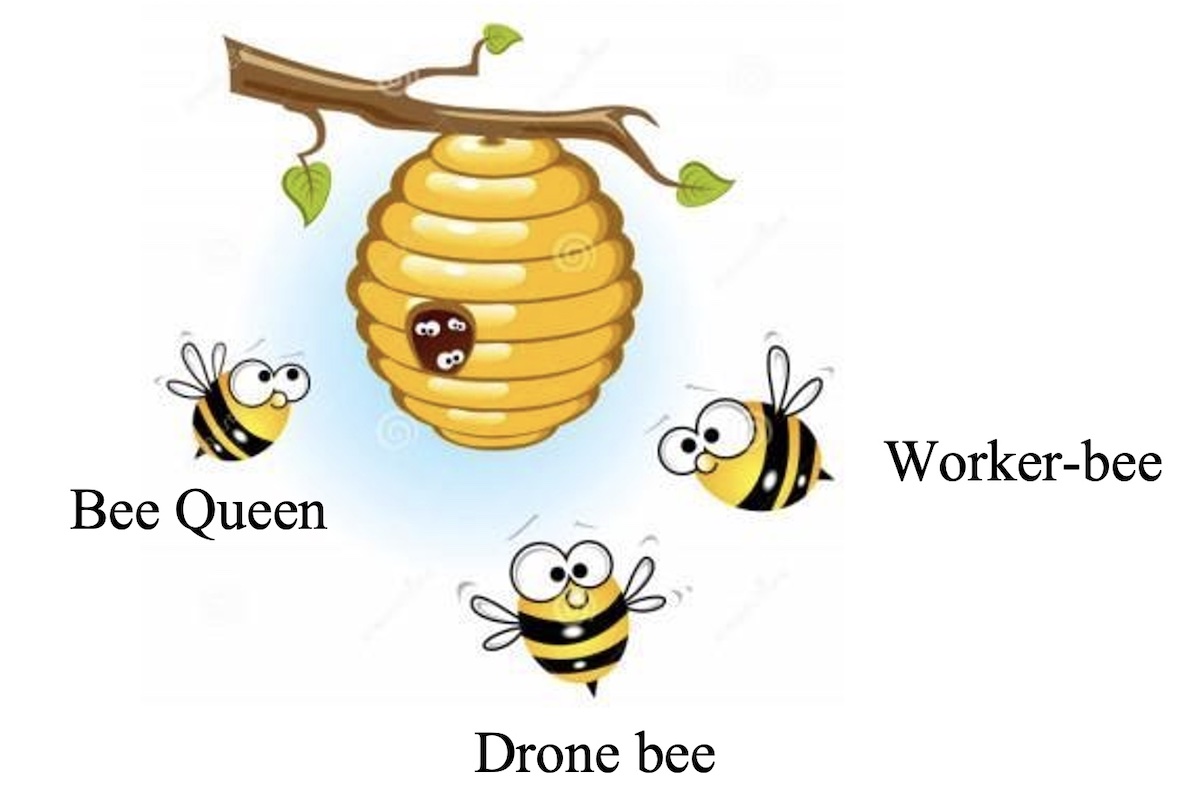
We have also drawn an analogy with a bee society. There are three key roles: the queen, the drones and the worker bees. It is clear that a drone cannot ‘work’ like a worker bee, and vice versa. In the workplace, the roles aren’t always quite so clear-cut, but when staffing or recruiting, it’s a very good principle to first clarify the job requirements and then start considering candidates. Otherwise, there’s a risk that someone who’s very good at their current role might be considered a candidate. You might then end up choosing an eagle to be a shark…
One final point on diversity. Several years ago, the members of a team took the HumanGuide test. One of the participants then said: ‘I’ve always found you, X, difficult to understand. NOW, having seen your test results, I understand you much better. And you are OK😍’
- Created on .